Tuesday, 20 September 2011

Visit North America

North America consists of three nations and one large island territory that encompass most of its area. They are Canada, USA, Mexico and Greenland. There are also 7 smaller nations at its southern around two dozen island nations and territories of various sizes in the Caribbean, and one isolated French territory off the Canadian Atlantic coast.
Although the Central American and the Caribbean regions are officially part of the North American continent, they are commonly listed separately from their larger neighbours to the north and hence the individual region names for both cultural and geographical causes.
In this continent many geographical places and manmade attractions attracts a number of visitors from outside this continent.

North America is the source of much of what humanity knows about geologic time periods. The geographical area that would later become the United States has been the source of further diversities of dinosaurs than any other modern country. This is primarily due to stratigraphy, climate and geography, human resources, and history. Much of the Mesozoic Era is symbolized by bare outcrops in the countless arid regions of the region. The most substantial dinosaur-bearing fossil deposit in North America is the Morrison Formation of the United States.
Before interaction with Europeans, the natives of North America were divided into many diverse civilizations, from trivial bands of a few families to large empires. They lived in several "culture areas", which roughly corresponds to topographical and biological zones and give a decent hint of the main lifeway or occupation of the people who lived there. Native groups can also be classified by their language family. Peoples with similar languages did not always share the same material culture, nor were they always allies.


To Read more click here

Sunday, 10 July 2011

Senegal - Exotic holiday

Senegal, 1,96,722 square kilometres is located in the westernmost part of the Africa continent. It is limited in the West by the Atlantic Ocean, in the North by Mauritania, in the East by Mali and in the South by Bissau Guinea and the Republic of Guinea. Its southern region of Casamance shares a border with the Republic of The Gambia. 
Senegal has the required assets for a blooming tourism industry. It is only a few hours away from major tourist markets; five hours away from Western Europe and about seven hours away from the East Coast of the United States. Besides it is a sunny country claiming more than 3000 hours of sunshine yearly. All forms of tourism can be experienced in Senegal seaside resorts (leisure, aquatic sports, horseback riding, discovery and more), cultural tourism, bird watching, sport tourism (hunting, scuba diving), ecotourism, historic museums, gorgeous natural sites, six major game parks and reserves, diversified fauna and flora to name a few. 

Despite various influences (Western influence due to a long French presence in West Africa, Middle Eastern influence due to a tradition of multiple exchanges with North Africa and Arab Countries), Senegal has its own brand of exotic music, food and customs that gives it the right dash of spice.

Its weather is tropical, hot and humid:
- the rainy season (May to November) has some strong southeast winds; 
- the dry season (December to April) is dominated by hot, dry, humid and harmattan winds.
Senegal is home to some of the most photographed beaches in the world. 

 The reefs and cays of the coastal are heaven for divers, holding out the promise of such extraordinary sightings of the underworld.
Dakar, the melting pot capital city, is one of the busiest cruise ships port in Africa and boasts an exciting restaurant and club scene, as well as duty-free shopping.

Don't forget to visit us

Thursday, 7 July 2011

Oxegen Starts Tomorrow 8th July 2011

Oxegen is an annual music festival in Ireland held since 2004, sponsored by Heineken. As of 2007, 2008, 2009, the festival has been cited as Ireland's biggest music festival. And by 2009, the festival is cited as the greenest festival, being a 100% carbon neutral event in Ireland.

It was previously called Witnness, which ran from 2000 and was sponsored by Guinness. The event is promoted by MCD. Oxegen was originally a three-day festival but for 2008 was expanded to four days. It takes place at the Punchestown Racecourse in County Kildare, Ireland and has an average attendance of around 90,000 a day, with around 80,000 of these camping on site for the duration, and the rest travelling to the site each day. It takes place on the same weekend as T in the Park in Scotland and shares a very similar line-up each year, although Oxegen is generally regarded as Ireland's version of the Glastonbury Festival, with the 2008 festival sharing three of the same headliners as its English counterpart.

Oxegen has attracted significant attention from outside Ireland, with many of those attending travelling from overseas experiencing a "mass exodus" to the festival. Members of bands such as The Killers, Snow Patrol and R.E.M. have spoken positively of their experiences at the festival. Celebrities frequently attend, including models Helena Christensen (a regular attendant) and television personality Chris Pontius, actor Josh Hartnett, and Ronnie Wood of The Rolling Stones, who was pursued by "half the journalists in the country" and many of his own relatives for much of the 2008 festival. The event has also attracted some negative publicity, particularly following the 2006 festival. This is attributed to such factors as the age of admission -17- and easy access to alcohol.

Oxegen, for two consecutive years, was named as the Best European Festival in a poll which included festivals from France, Netherlands, Spain, United Kingdom and other countries, leading The Sunday Business Post's Nicola Cooke to describe it as "one of the most successful music festivals in Ireland has ". Leagues O'Toole has described it as an "enormously successful, award-winning, established brand aimed at a young audience out for a good time, a post-Leaving Cert rite of passage perfect for acts with big sing-a-long tunes that sound great in the mud". Oxegen received a mention in the Colum McCann short story "Aisling". Visit here for Hotels

Saturday, 2 July 2011

The Musée du Louvre


The Musée du Louvre, or officially Grand Louvre – in English, the Louvre Museum or simply the Louvre – is one of the world's largest museums, the most visited art museum in the world and a historic monument. A central landmark of Paris, it is located on the Right Bank of the Seine in the 1st arrondissement (district). Nearly 35,000 objects from prehistory to the 19th century are exhibited over an area of 60,600 square metres (652,300 square feet).

The museum is housed in the Louvre Palace (Palais du Louvre) which began as a fortress built in the late 12th century under Philip II. Remnants of the fortress are still visible. The building was extended many times to form the present Louvre Palace. In 1682, Louis XIV chose the Palace of Versailles for his household, leaving the Louvre primarily as a place to display the royal collection, including, from 1692, a collection of antique sculpture. In 1692, the building was occupied by the Académie des Inscriptions et Belles Lettres and the Académie Royale de Peinture et de Sculpture, which in 1699 held the first of a series of salons. The Académie remained at the Louvre for 100 years. During the French Revolution, the National Assembly decreed that the Louvre should be used as a museum, to display the nation's masterpieces.
The museum opened on 10 August 1793 with an exhibition of 537 paintings, the majority of the works being royal and confiscated church property. Because of structural problems with the building, the museum was closed in 1796 until 1801. The size of the collection increased under Napoleon and the museum was renamed the Musée Napoléon. After the defeat of Napoléon at Waterloo, many works seized by his armies were returned to their original owners. The collection was further increased during the reigns of Louis XVIII and Charles X, and during the Second French Empire the museum gained 20,000 pieces. Holdings have grown steadily through donations and gifts since the Third Republic, except during the two World Wars. As of 2008, the collection is divided among eight curatorial departments: Egyptian Antiquities; Near Eastern Antiquities; Greek, Etruscan, and Roman Antiquities; Islamic Art; Sculpture; Decorative Arts; Paintings; Prints and Drawings.

Medieval, Renaissance, and Bourbon palace


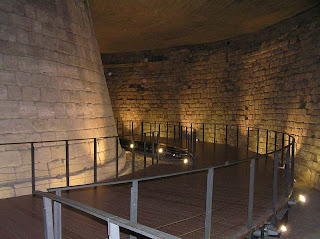
The only portion of the medieval Louvre still visible. The Louvre Palace (Palais du Louvre) which houses the museum was begun as a fortress by Philip II in the 12th century, with remnants of this building still visible in the crypt. Whether this was the first building on that spot is not known, but it is possible that Philip modified an existing tower. Although some believe that the word 'louvre' may refer to the structure's status as the largest in late 12th century Paris (from the French L'Œuvre, masterpiece) – or to its location in a forest (from the French rouvre, oak) – one finds in the authoritative Larousse that it derives from an association with wolf hunting den (via Latin: lupus, lower Empire: lupara).

The Louvre Palace was altered frequently throughout the Middle Ages. In the 14th century, Charles V converted the building into a residence and in 1546, Francis I (François 1er ) renovated the site in French Renaissance style. Francis acquired what would become the nucleus of the Louvre's holdings, his acquisitions including Leonardo da Vinci's Mona Lisa. After Louis XIV chose Versailles as his residence in 1682, constructions slowed; however, the move permitted the Louvre to be used as a residence for artists.
By the mid-18th century there was an increasing number of proposals to create a public gallery, with Lafont Saint-Yenne publishing, in 1747, a call for a display of the royal collection'. On 14 October 1750, Louis XV agreed and sanctioned a display of 96 pieces from the royal collection, mounted in the Galerie royale de peinture of the Luxembourg Palace. A hall was opened by Le Normant de Tournehem and the Marquis de Marigny for public viewing of the Tableaux du Roy on Wednesdays and Saturdays, and contained Andrea del Sarto's Charity and works by Raphael; Titian; Veronese; Rembrandt; Poussin or Van Dyck, until its closing in 1780 as a result of the gift of the palace to the comte de Provence by the king in 1778. Under Louis XVI, the royal museum idea became policy. The comte d'Angiviller broadened the collection and in 1776 proposed conversion of the Grande Galerie of the Louvre – which contained maps – into the "French Museum". Many proposals were offered for the Louvre's renovation into a museum, however none was agreed on. Hence the museum remained incomplete until the French Revolution.

French Revolution
During the French Revolution the Louvre was transformed into a public museum. In May 1791, The Assembly declared that the Louvre would be "a place for bringing together monuments of all the sciences and arts". On 10 August 1792, Louis XVI was imprisoned and the royal collection in the Louvre became national property. Because of fear of vandalism or theft, on 19 August, the National Assembly pronounced the museum's preparation as urgent. In October, a committee to "preserve the national memory" began assembling the collection for display.


Napoleon I
Under Napoleon I, a northern wing paralleling the Grande Galérie was begun, and the collection grew through successful military campaigns. Following the Egyptian campaign of 1798–1801, Napoléon appointed the museum's first director, Dominique Vivant Denon. In tribute, the museum was renamed the "Musée Napoléon" in 1803, and acquisitions were made of Spanish, Austrian, Dutch, and Italian works, either as spoils or through treaties such as the Treaty of Tolentino. After the French defeat at Waterloo, the works' former owners sought their return. The Louvre's administrators were loath to comply and hid many works in their private collections. In response, foreign states sent emissaries to London to seek help, and many pieces were returned, even some that had been restored by the Louvre. In 1815 Louis XVIII finally concluded agreements with Italy for the keeping of pieces like Veronese's Marriage of Cana which was exchanged for a large Le Brun or the repurchase of the Albani collection.

Restoration and Second Empire
The Venus de Milo was added to the Louvre's collection during the reign of Louis XVIII. During the Restoration (1814–30), Louis XVIII and Charles X between them added 135 pieces at a cost of 720,000 francs and created the department of Egyptian antiquities curated by Champollion, increased by more than 7,000 works with the acquisition of the Durand, Salt or second Drovetti collections. This was less than the amount given for rehabilitation of Versailles, and the Louvre suffered relative to the rest of Paris. After the creation of the French Second Republic in 1848, the new government allocated two million francs for repair work and ordered the completion of the Galerie d'Apollon, the Salon Carré, and the Grande Galérie. In 1861, Louis-Napoléon Bonaparte bought 11,835 artworks including 641 paintings of the Campana collection. During the Second French Empire, between 1852 and 1870, the French economy grew; by 1870 the museum had added 20,000 new pieces to its collections, and the Pavillon de Flore and the Grande Galérie were remodelled under architects Louis Visconti and Hector Lefuel.

Third Republic and World Wars
During the French Third Republic the Louvre acquired new pieces mainly via donations and gifts. The Société des Amis du Louvre donated the Pietà of Villeneuve-lès-Avignon, and in 1863 an expedition uncovered the sculpture Winged Victory of Samothrace in the Aegean Sea. This piece, though heavily damaged, has been prominently displayed since 1884. The 583-item Collection La Caze donated in 1869, included works by Chardin; Fragonard; Rembrandt – such as Bathsheba at Her Bath – and Gilles by Watteau.
Museum expansion slowed after World War I, and the collection did not acquire many significant new works; exceptions were Georges de La Tour's Saint Thomas and Baron Edmond de Rothschild's (1845–1934) 1935 donation of 4,000 engravings, 3,000 drawings, and 500 illustrated books. During World War II the museum removed most of the art and hid valuable pieces. On 27 August 1939, after two days of packing, truck convoys began to leave Paris. By 28 December, the museum was cleared of most works, except those that were too heavy and "unimportant paintings were left in the basement". In early 1945, after the liberation of France, art began returning to the Louvre.

Grand Louvre and the Pyramids
By 1874, the Louvre Palace had achieved its present form of an almost rectangular structure with the Sully Wing to the east containing the square Cour Carrée and the oldest parts of the Louvre; and two wings which wrap the Cour Napoléon, the Richelieu Wing to the north and the Denon Wing, which borders the Seine to the south. In 1983, French President François Mitterrand proposed the Grand Louvre plan to renovate the building and relocate the Finance Ministry, allowing displays throughout the building. Architect I. M. Pei was awarded the project and proposed a glass pyramid to stand over a new entrance in the main court, the Cour Napoléon. The pyramid and its underground lobby were inaugurated on 15 October 1988. The second phase of the Grand Louvre plan, La Pyramide Inversée (The Inverted Pyramid), was completed in 1993. As of 2002, attendance had doubled since completion.


Getting to the Louvre

Métro
Palais-Royal–Musée du Louvre station.
Bus
The following bus lines stop in front of the Pyramid: 21, 24, 27, 39, 48, 68, 69, 72, 81, 95, and the Paris Open Tour bus.
Car
An underground parking garage is available for those coming by car. The entrance is located on avenue du Général Lemonnier. It is open daily from 7 a.m. to 11 p.m.
Batobus
Get off at the Louvre stop, quai François Mitterrand.
From Orly Airport
Take the RER C train, direction Champs de Mars-Tour Eiffel, and get off at Saint-Michel-Notre-Dame. Walk to the place Saint-Michel and take bus no. 27, direction Saint-Lazare. Get off at the Louvre, in front of the Pyramid.
From Charles de Gaulle Airport
Take the RER B train, direction Massy-Palaiseau, and change at Châtelet-les-Halles to line 14, direction Saint-Lazare. Get off at Pyramides station and walk to the Louvre from there (3 minutes). Alternatively, take Métro line 1 at Châtelet-les-Halles, and get off at Palais-Royal–Musée du Louvre.

Thursday, 30 June 2011

World’s sexiest cities to go for holiday

What makes a city sexy? It's a quality that transcends the mere physical beauty of its inhabitants. We are talking about those special places that make you feel incredibly alive, where you shrug off the drab clothes of everyday experience almost as soon as you touch down.
That lightness of being does, it is true, often lead to thoughts about romance, and our sexy cities certainly have, shall we say, something of a reputation. Paris (in the springtime, of course) seems particularly good at macaroon-like affairs that are forgotten almost as soon as they are over; Sydney, bursting with buffed beach bodies, is just the spot for a bit of narcissistic nookie; Istanbul is all about the thrilling coming together of east and west.

Beirut

A model stalks the catwalk at a fashion show for Lebanese and Arab designers earlier this year in Beirut // A model stalks the catwalk at a fashion show for Lebanese and Arab designers earlier this year in Beirut (Hussein Malla/AP/PA) "Wherever you are in Beirut, you can feel the magic," laughs Stefan Simkovics, a local hotelier. "It's one of the sexiest cities in the world: enticing, vain, scarred, beautiful, complex and exciting."
Stroll past its countless outdoor cafés in the evening, and you'll notice how the inhabitants of Beirut love talking, eating and table-dancing - preferably all at once. The city's religious mix - Lebanon has by far the largest Christian population of any Arab country - also makes it one of the most tolerant in the region. "Like me, the city is unsure whether it's east or west, Christian or Muslim, Arab or European, serene or troubled, traditional or modern," says the celebrated Lebanese writer Rabih Alameddine.
With its sublime food and the boldest nightlife in the Middle East, Beirut is almost back to being the playground it was before the 1975 civil war and the catastrophic Israeli bombardment of 2006. Ski, sunbathe, cycle along the seafront, smoke a narghileh waterpipe - relax like the locals and consign serious talk to the bunkers of history. Spicy, flirty, sleek and dirty, battered but beautiful, Beirut zings with a zest for life.

Sydney: sexy lifestyles // Sydney: sexy lifestyles (Andrew Watson/Lonely Planet)
Sydney
 An early morning stroll around the harbour - the city's gorgeous natural attribute that most Sydneysiders maddeningly take for granted - reveals the buffed bodies of surfers and sailors, cyclists and body-builders, all blending into a sassy urban portrait of the good life. Sydney long ago dropped the cliché, beloved of the jealous British, of the uncultivated Australian simpleton. The city excels at sexily designed buildings, frocks... and lifestyles, for that matter.
The beautiful people flock to Finger Wharf, with its marina, buzzy bars and Blue Sydney, a showstopper hotel in the crazily named neighbourhood of Woolloomooloo Bay. Babes in strappy dresses schmooze in Tank nightclub, in the city centre; you can dine in style nearby at the famed Est restaurant.
From such fine-dining establishments to sand-between-your-toes cafés, Sydney is renowned as a place to satisfy your culinary lusts. The sleek set tuck into seafood at Guillaume at Bennelong, overlooking Circular Quay. At Bill's, in Darlinghurst, the celebrity chef Bill Granger is credited with creating so-called Aussie brekkie chic, with his tantalising corn fritter brunches. In Sydney, hedonism comes sizzling on a plate.

Rio de Janeiro

With its bikini and Speedo army on the beach and spontaneous samba on the street, Rio is hard to beat in the overtly sexy stakes. The setting is as sensual as the Cariocas themselves, as Rio residents are called. The setting sun drips down Sugarloaf Mountain and frames the open-armed statue of Christ the Redeemer with a fiery aura.
Ipanema, where the skimpy tanga style of briefs was first flaunted, is the hottest beach, lined with fashion boutiques and bars. But the sand acts as a unifying force, attracting fashionistas and favelas slum-dwellers alike.

The city's twin talents for rhythm and exhibitionism come to a head every year at Carnival, that annual exuberant parade of posturing and swing. Sensual samba and cocktails swigged at beach bars warm up the celebrations. Caipirinha, a cocktail of rum, lime and crushed sugar, is the beach babe's tipple of choice.


Hollywood

he sign gives away the ruling spirit: "Welcome to West Hollywood. Population: Fabulous." Known as WeHo, California's coolest city doesn't do false modesty. Set below the Hollywood Hills and bathed in an aquatic blue aura, like an early David Hockney painting, the city seems to exist in a perpetual summertime.
It is here that Hollywood hotshots party with mere mortals and play-act normality. The most committed night owls prefer nice-but-naughty WeHo to the better-behaved Beverly Hills. Sunset Tower, a swanky art deco hotel that looks like a Bakelite wireless set and where Marylyn Monroe once stayed, still attracts the in-crowd.

Monroe summed up the credo of the city, cruel but compelling to so many. "They'll pay you a thousand dollars for a kiss," she said, "but fifty cents for your soul." Inflation may have changed the price but not the premise.

Las Vegas

Vegas is a trashy pick-and-mix kaleidoscope of a city with a behind-the-bikesheds sexiness: you can munch in a mocked-up Eiffel Tower before punting in a Venetian gondola and then snoozing in an Egyptian pyramid. A margarita-fuelled passport to naughtiness in the desert, its charms are dangerous but hard to resist. Many visitors exit having bankrupted themselves in the casinos or having married - possibly officiated by an Elvis impersonator in a pink Cadillac - someone entirely unsuitable.
The former tabloid chief Piers Morgan describes the city's current transition thus: "Vegas is moving from pure sin city, offering booze, drugs, gambling and sex, to a more refined sexy city, offering a less sleazy but just as exciting high-end entertainment resort." For now, though, it's still a neon explosion that, if it can't be seen from space, probably should be.

Venice

Venice is the city we have all been to, if only in our imagination. It's an ancient urban centre that lends itself to lyricism. Nietzsche said of it that, if he searched for a synonym for music, he found "always and only Venice".
Traditional Venetian masks on display in Venice // Traditional Venetian masks on display in Venice (Rowan Miles/AP/PA)Venetian sexiness feels like end-of-the-affair sadness, with its strong currents of delicious sadness and self-pity. Melancholy and nostalgia lurk constantly around the city's dark canal corners. The city reflects moods, aided by the capricious lagoon light. The writer Jonathan Keates describes Venice seductively as "the great masseuse of our hankerings and illusions: she discovers us not for what we are but for what each of us would like to be".

Wednesday, 29 June 2011

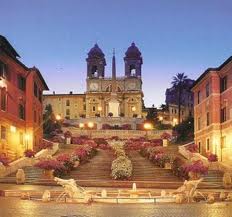
Rome’s Spanish Steps

Rome’s Spanish Steps and the piazza at their base are, collectively, both an incredibly romantic spot to spend an evening with a sweetheart on your arm and also a place to get royally ripped off by vendors and pickpockets alike. Your opinion of the area will certainly depend on which end of the spectrum your experience settles in. Let’s try to make sure you end up more with stars than rage ?

The Spanish Steps (Scalinata della Trinità dei Monti in Italian) is, as the name suggests, a long and grand staircase in Rome which connects two piazze – the Piazza di Spagna at the base and the Piazza Trinità dei Monti at the top. The stairway was built in the 1720s in an effort to connect the Vatican with the Spanish embassy (hence the name). The building at the top of the steps is the Trinità dei Monti, a church built in the 16th century.

The Spanish Steps serve as the backdrop for many displays and events throughout the year in Rome, including extraordinary floral displays in the spring, a nativity scene at Christmas, and a fashion show called Donna Sotto le Stelle in the summer. What you won’t see on the steps, however, is people sitting down and snacking – that’s against the law in Rome. Eat your lunch at a proper table in a cafe or restaurant, or picnic in an approved picnic spot, but not on the Spanish Steps – herein lies the first tip that will help you avoid trouble during your visit to this landmark.
There are a couple of things worth noting in the Piazza di Spagna at the base of the steps – the fountain in the center of the piazza, called Fontana della Barcaccia (Fountain of the Old Boat), and the house where English poet John Keats died in 1821. The building is to the right of the steps, just as you are beginning to climb. Today, the building houses a Keats museum.
Now, a few more tips to keep your Spanish Steps experience positive:
The evenings are certainly more romantic, but they’re also when pickpockets come out in higher numbers. Busy times in the piazza make it easier for them to work their magic, so keep an eye on your belongings.
Restaurants and cafes in the area get to raise their prices because they’re right next to a major tourist attraction, so avoid paying through the nose for a mediocre espresso or gelato by eating elsewhere and strolling to the Spanish Steps afterwards.
Be prepared to ignore the people selling individual roses or, worse, crappy trinkets and toys to tourists. They’ll follow you, and be rather insistent. Ignore them if you can. If you can’t, walk away and let someone else be the sucker.

Book you holiday with shortstayholiday 

Sunday, 26 June 2011

Biblical Tourist places - Sea of Galilee

View from Arbel
The Plain of Gennesaret spreads out below the Arbel cliffs.  About five miles long and two miles wide, this stretch of land alongside the Sea of Galilee's northwest shore was renowned for its fertility.  Josephus wrote that it was  "wonderful in its characteristics and in its beauty.  Thanks to the rich soil there is not a plant that does not flourish there, and the inhabitants grow everything: the air is so temperate that it suits the most diverse species."


From Northwest
The Sea of Galilee is fed by the Jordan River, rainfall and springs on the northern side.  More properly designated a lake, the Kinneret (the OT and modern name) is 13 miles long and 7 miles wide.  At its deepest point the lake is only 150 feet deep.  The rabbis said of it, "Although God has created seven seas, yet He has chosen this one as His special delight."


Hippos and Harbors
Hippos (Susita) was a major city of the Decapolis located on a round hill overlooking the shore.  The modern harbor of Kibbutz En Gev is visible below it.  In the first century, at least 16 harbors were located on the lake.  All the lake's settlements had their own harbor, even if it was very small.  The largest one belonged to Gadara had a 200 meter breakwater.


Wooden Boat Reconstruction
In 1986 a wooden vessel from the first century was discovered near Nof Ginosar on the lake's northwestern shore.  Studies have determined the type of wood that was used (mainly cedar and oak), the style of construction (mortise and tenon joints), the date (on the basis of construction techniques, pottery and Carbon 14 tests) and the size (26 by 7 feet - big enough for 15 men).  Pictured at right is a reconstruction of what the ancient boat might have looked like.  This was formerly on display at Kibbutz En Gev.


St. Peter's Fish
Three types of fish were primarily sought by fishermen in antiquity in these waters.  Sardines likely were the "two small fish" that the boy brought to the feeding of the 5000.  Sardines and bread were the staple product of the locals.  Barbels are so known because of the barbs at the corners of their mouths.  The third type is called musht but is more popularly known today as "St. Peter's Fish."  This fish has a long dorsal fin which looks like a comb and can be up to 1.5 feet long and 3.3 lbs in weight.


Sunset
The peaceful calm of the Sea of Galilee can quickly become transformed by a violent storm.  Winds funnel through the east-west aligned Galilee hill country and stir up the waters quickly.  More violent are the winds that come off the hills of the Golan Heights to the east.  Trapped in the basin, the winds can be deadly to fishermen.  A storm in March 1992 sent waves 10 feet high crashing into downtown Tiberias and causing significant damage. 


More images

See of Galilee